

RingCentral vs. Zoom Phone 2026: Which Agentic AI Actually Cuts Contact Center Costs?
Daniel Zvi
 246
246
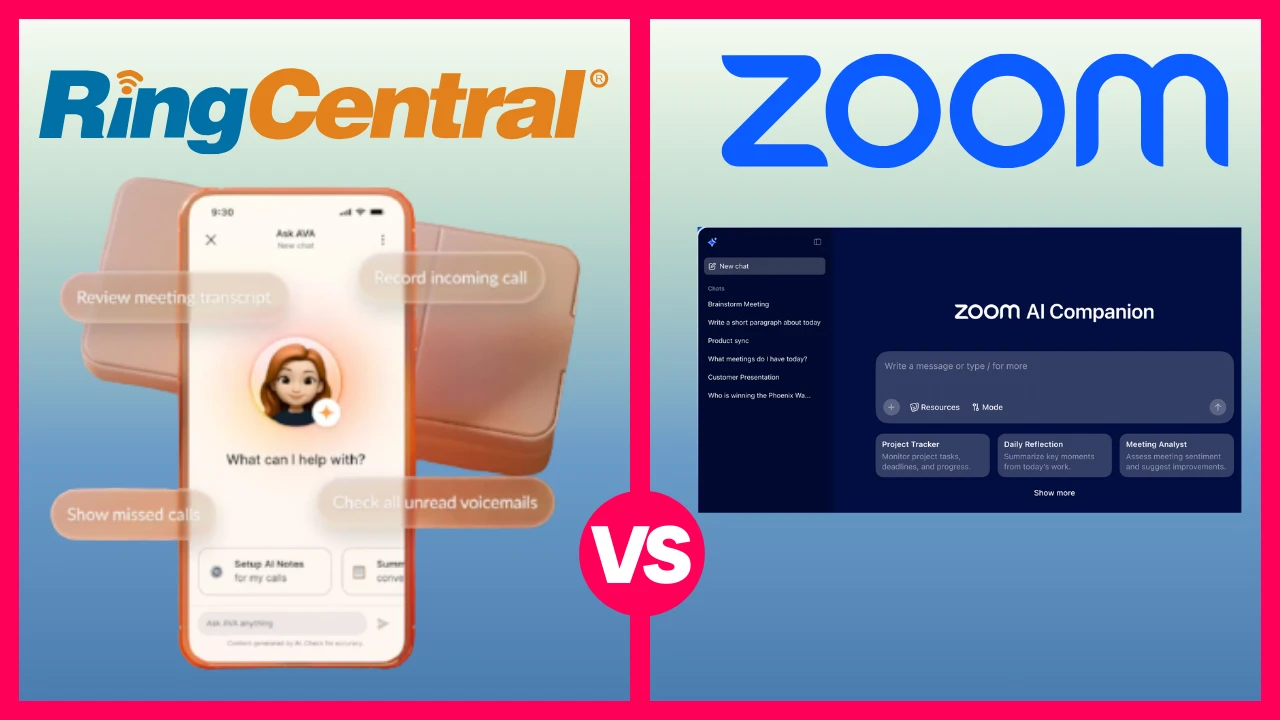
For years, the choice between RingCentral and Zoom was simple: RingCentral for phone power, Zoom for video ease. But in 2026, the conversation has shifted. It is no longer about call quality—it is about Agentic AI.
If you need a "Digital Worker" to autonomously answer calls, resolve IT tickets, and update CRMs without human intervention, RingCentral is your labor-saving solution. If you need an "AI Companion" to summarize meetings and streamline employee collaboration, Zoom remains the productivity king.
The core difference lies in their architecture: RingCentral automates the work; Zoom assists the worker.
General Overview RingCentral vs. Zoom
For enterprise contact centers, the battleground has moved from managing calls to deflecting them. Financial services, healthcare, and high-volume service industries are adopting Agentic Voice AI to reduce ticket costs and handle complex internal operations.
RingCentral has positioned itself as the leader in this space with its "Agentic" suite (AIR, AVA, ACE), designed to replace legacy phone trees. Zoom Phone leverages its massive user base to offer the Zoom AI Companion, a productivity tool that excels at summarization and meeting efficiency, making it a strong contender for Unified Communications (UCaaS) but less specialized for autonomous high-volume workflows.
Comparison Table: The Enterprise Snapshot
| Feature | RingCentral (RingCX / MVP) | Zoom (Zoom Phone / Contact Center) |
| Best For | Automated Operations (Labor Replacement) | Unified Collaboration (Productivity) |
| Core Wedge | Agentic AI (Action-Taking Digital Workers) | AI Companion (Passive Assistance) |
| Key AI Agent | AIR (AI Receptionist) | Zoom Virtual Agent |
| Ticket Cost Impact | Proven reduction to ~$3/ticket | Lower operational overhead via efficiency |
| CRM Integration | Write-Back (Deep Data Entry) | Read-Only (Pop-ups & Context) |
| Platform Type | Voice-First, Workflow-Centric | Video-First, Meeting-Centric |
| Starting Price | ~$30/user (Core) + AI Add-ons | ~$15/user (Core) + AI Included |
RingCentral at a Glance
RingCentral is a cloud communications veteran that has aggressively pivoted toward Agentic AI. Their new architecture treats AI not just as a feature, but as a "Digital Worker" capable of autonomous tasks. With tools like RingCentral AIR (AI Receptionist), they target the elimination of legacy phone trees, specifically aiming to reduce internal IT and HR operational friction in complex sectors like financial services.

Zoom Phone at a Glance
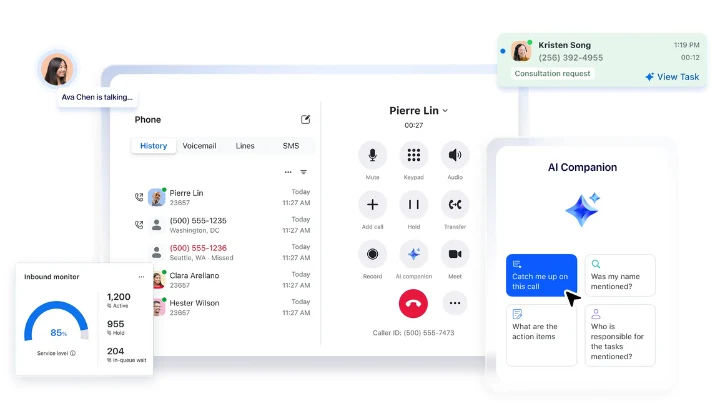
Zoom Phone is the rapid-growth challenger that successfully converted millions of video users into phone users. Their AI strategy revolves around the Zoom AI Companion, a federated AI approach that provides excellent meeting summaries, sentiment analysis, and drafting assistance at a very aggressive price point (often included in plans).
Zoom vs. RingCentral Pricing Breakdown
RingCentral Pricing
RingCentral utilizes a quote-based model for its advanced Enterprise and Contact Center (RingCX) solutions, though core plans are standard.
- Core Plans (MVP): Typically range from $30 - $45/user/mo.
- Agentic AI (AIR): Available as an add-on (approx. $59/mo for standalone instances) or integrated into enterprise quotes.
- Hidden Value: The ROI here is labor reduction. RingCentral's internal data suggests their AI agents can reduce the cost per support ticket from $15-$22 (human) to just $1-$5 (AI).
Zoom Phone Pricing
Zoom is known for aggressive, transparent pricing, though their full-blown Contact Center solution moves into higher tiers.
- Zoom Phone: Starts at $10/user/mo (Metered) to $15/user/mo (Unlimited).
- Zoom Contact Center: Starts around $69/agent/mo up to $149/agent/mo.
- Hidden Value: Zoom AI Companion is included in paid plans at no extra cost, a major value driver for general business users who want summaries without line-item add-ons.
Which Offers Better Value?
- For pure software costs: Zoom is cheaper upfront.
- For operational ROI: RingCentral offers better value for high-volume enterprises. If you can deploy RingCentral AIR to handle 40% of your inbound IT or HR requests, the labor savings far outweigh the higher monthly software fees.
Core Features Comparison
RingCentral Features: The Agentic Suite
RingCentral’s new "Agentic" architecture allows AI to carry context across workflows, effectively acting as an employee.
 Our top picks for March 2026
 9.3
9.3


 Cloud phone system
- AIR (AI Receptionist): A "before the conversation" agent. It answers calls 24/7, filters spam, and autonomously books appointments or updates CRMs (Salesforce/HubSpot) without human input.
- AVA (AI Virtual Assistant): A "during the conversation" agent. It listens to live calls and provides real-time coaching, document retrieval, and compliance checklists to the human agent.
- ACE (AI Conversation Expert): An "after the conversation" engine that analyzes massive datasets to provide structural insights and long-term trend forecasting.
- Digital Worker Orchestration: Unlike simple bots, these agents can handle complex internal ops (e.g., IT password resets, benefits enrollment) to relieve pressure on internal departments.
- Native CRM Data Entry: Automatically logs structured data (intent, sentiment, outcomes) directly into business systems.
Zoom Phone Features: The Productivity Companion
Zoom focuses on making the human user more efficient through summarization and smart drafting.
Our top picks for March 2026

- AI Companion Summaries: Industry-leading capability to summarize phone calls and meetings, automatically emailing action items to participants.
- Zoom Virtual Agent: An intelligent conversational AI (formerly Solvvy) that handles chat and voice deflection, capable of resolving simple queries.
- Smart Compose: AI-assisted drafting for SMS and team chat responses associated with phone numbers.
- Power Pack: An add-on for receptionists and executives that provides a persistent panel for call handling, enhanced by AI routing.
- Video Elevation: Seamlessly elevate a phone call to a video meeting with one click, bringing AI meeting features into play.
Summary Table: Feature Coverage
| Feature | RingCentral (Agentic) | Zoom Phone (Companion) |
| Autonomous Appointment Booking | ✔ (Native AIR) | ✖ (Requires config) |
| Real-Time Agent Coaching | ✔ (AVA) | ✔ (Contact Center tiers) |
| Ticket Cost Reduction Focus | ✔ (Proven $1-$5/ticket) | ✖ (Productivity focused) |
| Meeting/Call Summarization | ✔ | ✔ (Best in Class) |
| Internal Ops Automation (HR/IT) | ✔ (High Specialization) | ⚪ (General) |
UX, Integrations & Support
User Experience (UX)
- RingCentral: The interface is robust and data-heavy. It is designed for "Power Users" and Contact Center managers who need deep visibility into "Digital Worker" performance. The setup for AIR is intuitive (learning from FAQs/Documents), but the backend is complex.
- Zoom: Capitalizes on familiarity. If your team can use Zoom Meetings, they can use Zoom Phone. It is cleaner, simpler, and has a lower learning curve for general staff, though less granular for complex contact center routing.
Integrations
- RingCentral: Focuses on deep integration. Their "Agentic" workflow relies on reading/writing to Salesforce, HubSpot, and Microsoft Teams. It doesn't just "connect"; it performs data entry, ensuring no interaction goes unlogged.
- Zoom: Offers a massive app marketplace. Excellent integrations for scheduling and email (Google/Microsoft), but the "write-back" capabilities for autonomous agents are generally less advanced than RingCentral's new architecture.
Support
- RingCentral: Offers enterprise-grade reliability (99.999% SLA) and specialized support for implementing AI workflows in regulated industries like Finance and Healthcare.
- Zoom: Strong support, but often relies on self-service/chat for lower tiers.
Final Verdict: RingCentral vs. Zoom Phone
Choose RingCentral If:
- You run a high-volume Contact Center: You need to deflect routine calls (IT, HR, Customer Service) using "Digital Workers" (AIR).
- You need "Agentic" Automation: You want AI that does the work (books the appointment, updates the CRM), not just summarizes the call.
- You are in a Regulated Industry: You are in Financial Services or Healthcare and need compliant, secure AI handling of sensitive internal operations.
- ROI is your primary metric: You are targeting the reduction of ticket costs from ~$20 to ~$3.
Choose Zoom Phone If:
- You need Unified Communications: Your primary goal is merging video, phone, and chat into one simple interface.
- You prioritize Meeting Productivity: Your team needs excellent call summaries and action items more than autonomous call handling.
- Budget is the main driver: You want a low cost-per-user with AI features included for free.
- You are a SMB: You need a phone system that "just works" with zero training required.
Closing Thought: Zoom makes your employees faster. RingCentral does the work for them.
Want to explore further? 👉 Read our full RingCentral Review or Zoom Phone Review.
Frequently Asked Questions
Q. Does Zoom have an AI Receptionist like RingCentral AIR?
A. Zoom offers the "Zoom Virtual Agent," which is a conversational AI for chat and voice deflection. However, RingCentral AIR is more specifically marketed as a "Digital Worker" that mimics a receptionist's full workflow (answering, booking, logging) out of the box.
Q. Which is better for Financial Services internal operations?
A. RingCentral is the superior choice for this niche. Their "Agentic" tools are specifically tuned to handle internal IT helpdesk and HR benefits inquiries, ensuring compliance and reducing the burden on internal teams.
Q. Is RingCentral AI expensive?
A. While RingCentral AIR is an add-on cost, the value comes from labor replacement. Data indicates that deploying AI agents for routine tickets can reduce the cost per ticket by over 80% compared to human agents.
Q. Can Zoom AI Companion answer phone calls?
A. No. The Zoom AI Companion is designed to assist humans by summarizing calls and drafting follow-ups. It does not answer the phone for you; that requires the separate "Zoom Virtual Agent" product.
Q. Which integrates better with Salesforce?
A. RingCentral generally offers deeper Salesforce integration for contact centers, allowing its AI agents to automatically write structured data (intent, sentiment) directly into the CRM fields, whereas Zoom's integration is often focused on screen-pops and logging call activities.
Liked this article?
Daniel Zvi
 Related Articles



Smart Recommendations




Thank you!