


 Connect from virtually anywhere, anytime

 Caller ID-block
 Limited range of devices





Telecommunications in Canada has historically been expensive, dominated by a few major players. But the landscape has changed. With high-speed fiber and 5G internet now standard across most of the country, switching to a VoIP phone service is the smartest financial move a Canadian business can make.
These systems move your communications to the cloud, allowing you to make calls, manage virtual phone numbers, and video conference from anywhere—whether you’re at a cottage in Muskoka or a high-rise in downtown Montreal. By cutting the cord on traditional copper lines, you gain flexibility and significantly lower your monthly overhead.
 Our top picks for April 2026
 9.9
9.9

 Centralized management
What is VoIP and Why Switch?
VoIP (Voice over Internet Protocol) turns your voice into digital data packets sent securely over the internet. Unlike traditional landlines that tie you to a desk, VoIP lets you work from your smartphone, laptop, or tablet.
For Canadian businesses, the switch offers three massive advantages:
- Cost Savings: Avoid the high long-distance fees associated with traditional Canadian carriers.
- Local Presence: You can easily acquire virtual numbers with local area codes (like 416, 604, 514, or 902) to establish trust in specific local markets, even if your office is elsewhere.
- Resilience: Cloud systems aren’t susceptible to local power outages in the same way on-premise hardware is, provided you have a mobile backup.
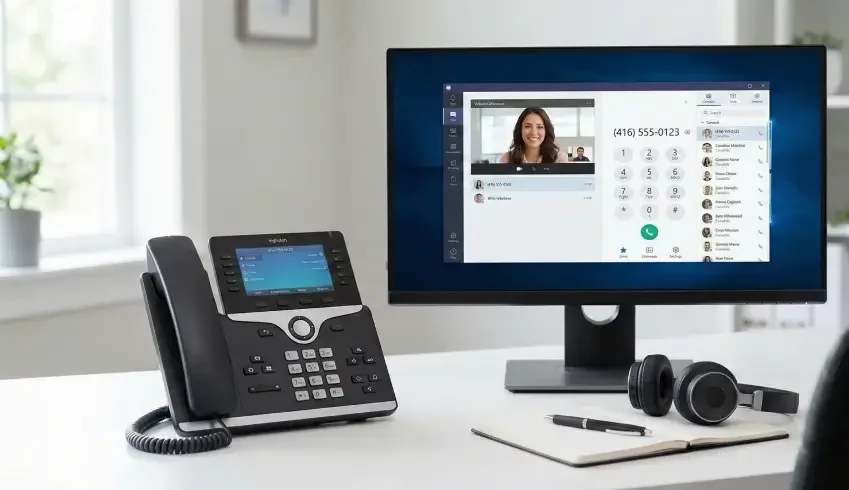
Recommended Canadian VoIP solutions
We’ve evaluated the market based on strict criteria: call latency, data residency options, ease of use, and cost per user (CAD). Whether you need a simple cloud-based phone line for a side hustle or a Unified Communications (UCaaS) platform for a growing enterprise, our top picks are trusted by Canadians from coast to coast.
These are the most recommended VoIP systems for Canadian reliability:
Key Features for Canadian Businesses
When evaluating a VoIP service in Canada, look for these specific capabilities:
- Canadian Area Codes & Porting: Ensure the provider offers numbers in every province and supports “Number Porting” (LNP) so you can keep your existing business number.
- E911 Compliance: Unlike standard 911, Enhanced 911 (E911) automatically sends your location data to emergency dispatchers. This is a critical regulatory requirement for VoIP in Canada.
- Bilingual Interface: If you operate in Quebec or serve French-speaking customers, look for platforms that offer voicemail transcriptions and interfaces in both English and French.
- Unlimited Canada/US Calling: Most top-tier providers include unlimited calling across North America, eliminating “long-distance” shock on your bill.
- Mobile & Desktop Apps: The ability to flip a call from your desk phone to your mobile app without disconnecting is essential for modern hybrid work.

Choosing the Right Provider
There is no “one size fits all,” but the best provider for you should check these boxes:
- Reliability: Look for a 99.999% uptime SLA to ensure your phones never go down.
- Unified Communications: Since you are paying for the service, it makes sense to choose a provider (like Zoom or RingCentral) that combines Phone, Video, and Chat in one app. This reduces “app fatigue” for your staff.
- 24/7 Support: Ensure they offer support during your business hours, regardless of your time zone (PST to NST).
Excited to modernize your communications? Check out our in-depth reviews, compare the features, and choose the partner that will help your business connect better.
Our top picks for April 2026
Frequently asked questions
Q. What is a virtual phone number and how does it work?
A. A virtual phone number isn’t tied to a physical phone line. It works over the internet using VoIP systems, allowing you to make and receive calls from any device—desktop, mobile, or tablet.
Q. Can I make online calls using VoIP?
A. Yes. VoIP phone services enable crystal-clear online calls using your internet connection. Whether you’re calling clients, running a support line, or managing remote teams, VoIP ensures reliable voice quality without traditional phone lines.
Q. What’s the benefit of using VoIP numbers in Canada?
A. VoIP numbers let you choose local or toll-free area codes regardless of your actual location. They’re flexible, cost-effective, and ideal for businesses operating in multiple provinces or cities.
Q. How is an online phone different from a traditional phone system?
A. An online phone or cloud-based VoIP system uses the internet to manage calls, voicemail, routing, and more—no hardware required. It’s more scalable and mobile-friendly than traditional landlines.
Q. Are VoIP systems reliable in Canada?
A. Yes. With strong internet infrastructure and providers offering Canadian-based support, VoIP systems in Canada are fast, secure, and compliant with local telecom regulations.
Q. Is VoIP legal and regulated in Canada?
A. Yes, VoIP is fully legal and regulated by the CRTC (Canadian Radio-television and Telecommunications Commission). Legitimate providers must adhere to strict rules regarding privacy, number porting, and 911 services.
Q. Can I keep my existing Canadian phone number?
A. Yes. Under Canadian “Number Portability” rules, you have the right to take your phone number with you when switching from a traditional carrier (like Bell or Rogers) to a VoIP provider. The process usually takes 5-7 business days.
Q. Do I need a specialized IP Phone?
A. Not necessarily. Most modern VoIP services offer “Softphones”—apps that run on your existing computer or smartphone. However, if you prefer a physical desk phone, you can buy IP-enabled hardware that plugs directly into your internet router.
Q. How much data does a VoIP call use?
A. VoIP is very efficient. A typical high-quality call uses about 100KB of data per minute. Even a basic business internet plan can handle multiple concurrent VoIP calls without slowing down.
Our top picks for April 2026
